Cloud types / Cirrus
Cirrus · Ci
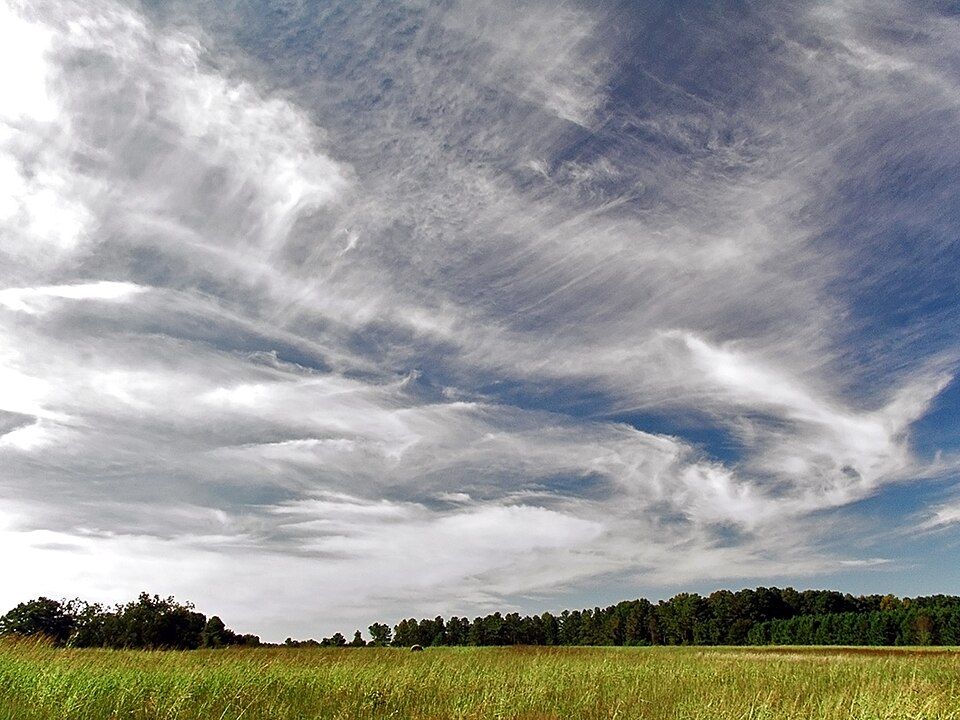
| Cloud level | High |
| Altitude | Base roughly 5-13 km |
Cirrus clouds appear as detached, delicate filaments, narrow white patches, or narrow bands across an open blue sky. Composed entirely of ice crystals, they have a distinctly fibrous, hair-like appearance and a silky sheen. Because strong upper-atmosphere winds blow and stretch these crystals into hooked or feathery trails, they often signal shifting jet stream patterns and can warn observers of an approaching warm front or weather disturbance well before surface conditions change.
How it forms
Cirrus forms when ascending air cools below freezing at high altitudes, causing water vapor to deposit directly into ice crystals. Strong winds aloft then shear and distribute these falling ice crystals horizontally into long, delicate plumes or curved strands commonly referred to as mare's tails.
Identification keys
- Detached, delicate, hair-like white filaments
- Fibrous or silky optical appearance without shading
- Composed entirely of ice crystals
- Often shaped into hooks, feathers, or long wisps
- Sun shines brightly through them without cast shadow
Typical weather
Cirrus produces no precipitation reaching the ground, though falling ice crystals may form virga aloft. Isolated patches indicate fair weather, while dense, steadily invading cirrus from the west often heralds the approach of a warm front.
Often confused with
Photography tip
Use a polarizing filter and slightly underexpose to emphasize delicate white filaments against a deep blue sky.
Questions about this cloud
Can cirrus clouds produce rain or snow on the ground?
No, precipitation from cirrus evaporates or sublimates as virga high in the atmosphere long before reaching the ground.
Why do cirrus clouds often look hooked or curled?
Falling ice crystals enter wind layers with different speeds or directions, pulling the cloud tails into characteristic hooked shapes.
Got a photo like this? Run it through the identifier: