Cloud types / Altostratus
Altostratus · As
| Cloud level | Mid |
| Altitude | Base roughly 2-7 km |
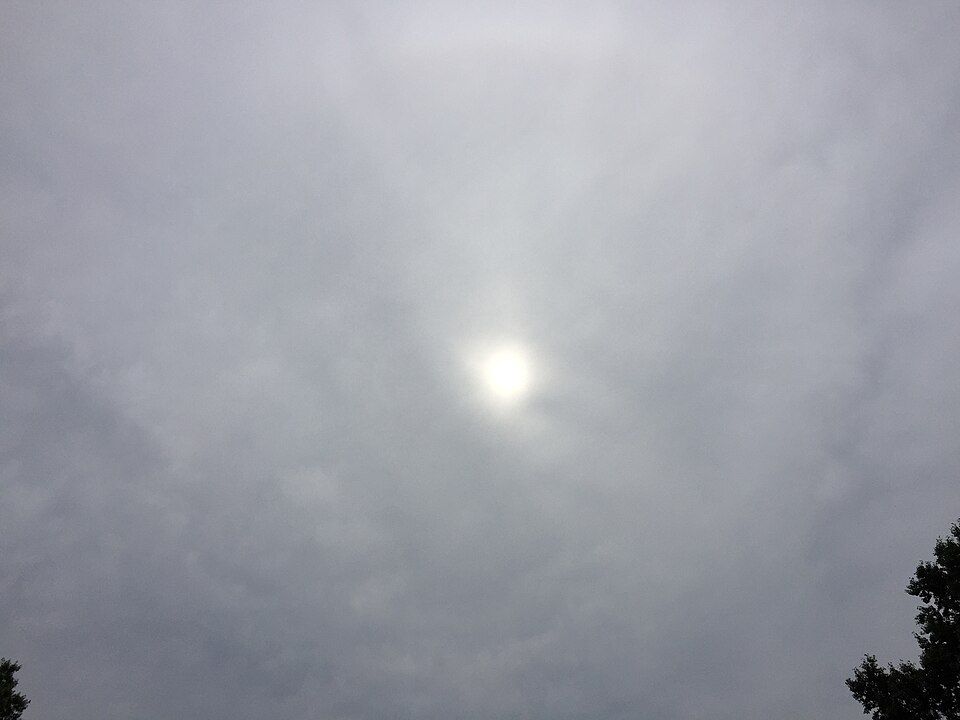
Altostratus appears as a gray or bluish sheet or layer of striated, fibrous, or uniform appearance that covers large areas of the sky. Thin sections reveal the sun or moon weakly, as though illuminated through ground glass, without creating halo phenomena. As a classic middle-level cloud sheet, it frequently signals an approaching warm front or occluded front, marking the transition from high cirrostratus toward thicker, weather-bearing cloud systems.
How it forms
Altostratus forms primarily through the slow, widespread ascent of extensive air masses, often along frontal boundaries such as warm fronts. As moist air gradually cools at middle altitudes, water droplets and ice crystals condense across vast horizontal areas. It can also develop when a thickening cirrostratus layer descends and densifies.
Identification keys
- Grayish or bluish sheet with a fibrous, striated, or uniform appearance
- Sun or moon dimly visible through thinner parts like through frosted glass
- Objects on the ground cast no shadows when the sun shines through
- Does not exhibit halo phenomena around the sun or moon
- Forms an extensive layer covering vast expanses of the sky
Typical weather
Altostratus typically indicates approaching deterioration in weather, often preceding frontal precipitation. It normally produces no precipitation reaching the ground, although virga can hang beneath the cloud base. Thicker varieties gradually lower and darken, often transitioning directly into rain-bearing nimbostratus.
Often confused with
Photography tip
Include a faint sun disc and horizon elements to capture the characteristic frosted-glass effect without overexposing the muted cloud texture.
Questions about this cloud
Can altostratus produce a halo around the sun?
No, halo phenomena are exclusive to high ice-crystal clouds such as cirrostratus. Altostratus may reveal the sun dimly like ground glass, but it never produces halos.
Does altostratus bring rain to the ground?
Altostratus itself normally produces no precipitation reaching the ground, though falling trails called virga may evaporate mid-air. When steady rain or snow reaches the surface, the cloud has thickened into nimbostratus.
Got a photo like this? Run it through the identifier: